
Noise
One of the main problems with Earth-based detection is noise. The LIGO detectors are very sensitive to many kinds of noise including:
- Thermal: fluctuations of the atoms within the mirrors of the interferometer
- Seismic: earthquakes, wind, ocean waves and human noise such as cars or trains
- Gas: any air particles can interact with the laser light or mirrors
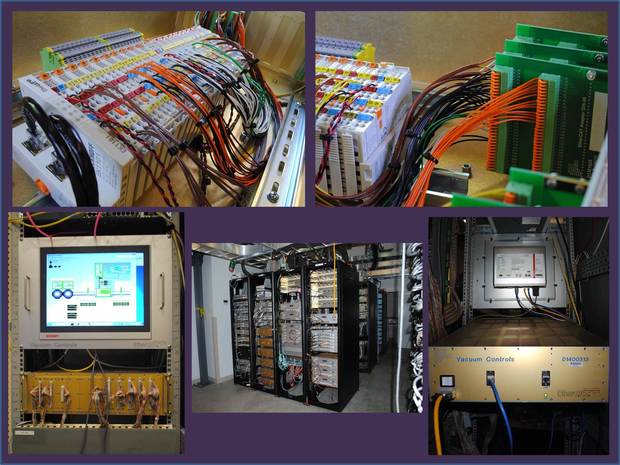
- Electronic: created by the machinery making up an interferometer
Background noise makes up most of a set of data and therefore measures must be taken to reduce the noise as much as possible. This makes it easier to locate any signals.
Examples of measures are:
- The arms of interferometers are kept in a vacuum, this removes as many air molecules as possible from the chamber. This vacuum is noisy, however, adding to the electronic noise
- LIGO reduces noise created by seismic activity with actuators that counteract vibrations and a quadruple pendulum system
- By looking at noise that repeats itself, (e.g. a train passes close by every week at the same time) vetoes can be programmed into the data analysis to automatically remove the noise at that specific time
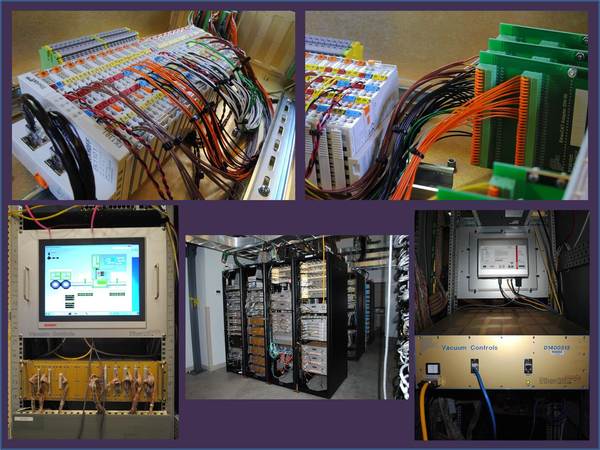
Image: Caltech/MIT/LIGO Lab
Glitches
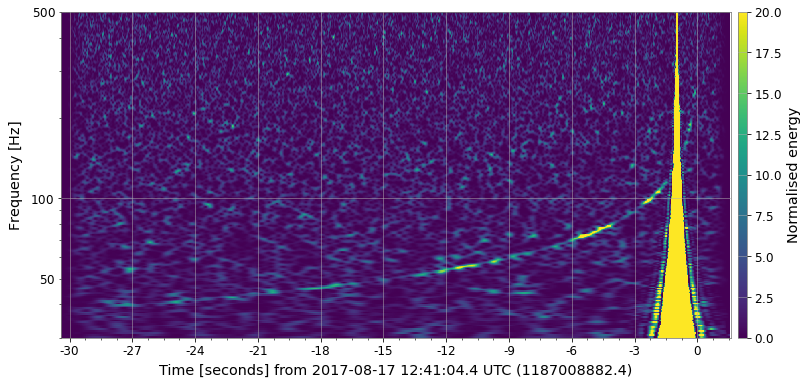
As seen in here sometimes when we re-weight our data, what we thought were signals can be glitches instead. These can be loud blips in the data, that look like signals at first but do not fit our templates. Glitches can be categorized by their shapes, which can be useful in grouping glitches to find their source, and eliminate them in the future.
Sometimes we’re really unlucky and glitches can appear in front of gravitational signals. This is why having as many interferometers online as possible is important. If one has a glitch, hopefully the others still caught the signal.
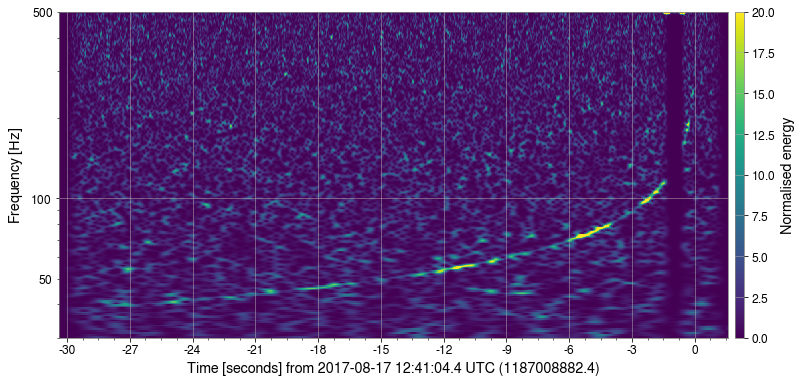
However, sometimes we can remove the glitch from in front of the signal, this is called gating. As you can see, this essentially removes the chunk of data including the glitch and therefore should only be used when really necessary.
Data: GWOSC